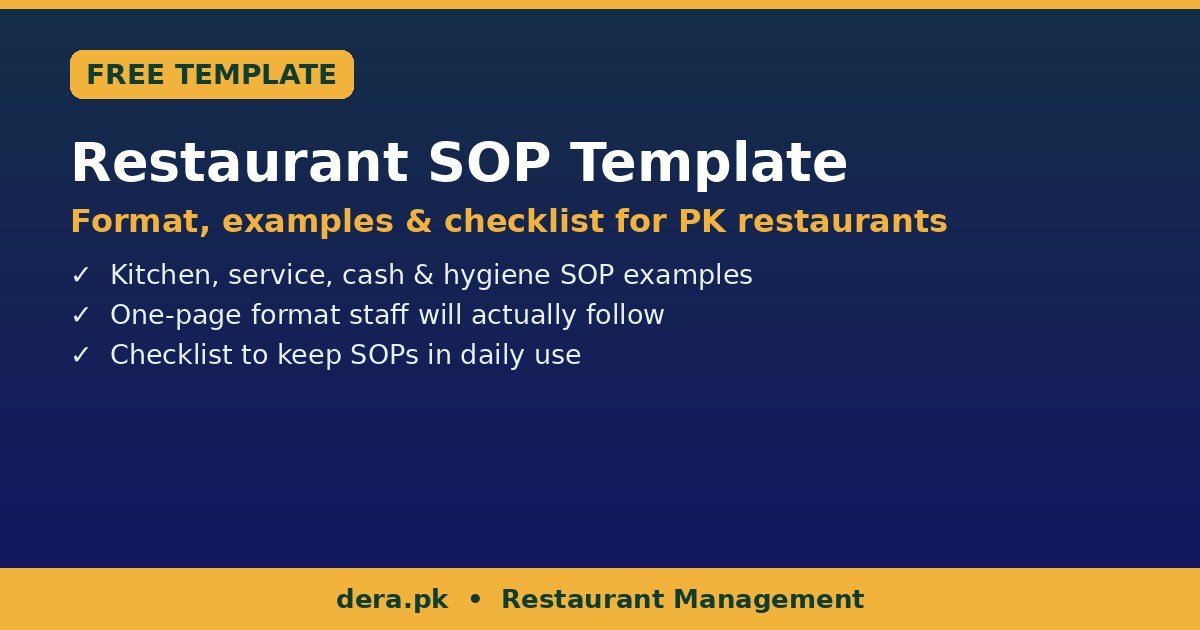
Restaurant SOP Template: Format, Examples and Checklist
Direct answer: A restaurant SOP (Standard Operating Procedure) is a short written instruction that tells staff exactly how to do one task the same way every time — for example, opening the kitchen, taking an order, or closing the cash counter. A good SOP template has a title, purpose, who is responsible, the tools needed, numbered steps, and a check/sign-off. Below you’ll find a ready format and real examples you can adapt for your restaurant.
What does SOP mean in a restaurant?
SOP stands for Standard Operating Procedure. In a restaurant, it is the “one right way” to do a task. Without SOPs, every waiter, cook and cashier does things their own way. Food tastes different depending on who is cooking, service speed changes by shift, and cash differences appear that nobody can explain.
With SOPs:
- New staff learn faster.
- Quality stays the same across shifts and branches.
- Managers can check work against a clear standard.
- You’re better prepared for food authority inspections.
What is the difference between an SOP and a checklist?
An SOP explains how to do a task, step by step. A checklist is a quick tick-list to confirm the tasks were done. You need both: the SOP for training, the checklist for daily control. Our restaurant opening and closing checklist works alongside the SOPs below.
What should a restaurant SOP format include?
Keep every SOP to one page if you can. Staff won’t read a 10-page document.
What is a simple SOP template?
SOP No.:            [e.g. KIT-01]

Title:              [e.g. Kitchen Opening]

Department:         [Kitchen / Service / Cash / Store / Cleaning]

Purpose:            [Why this task matters – one line]

Responsible:        [Job title, not a person's name]

When:               [Time / frequency]

Tools & materials:  [What is needed]

Steps:

  1.

  2.

  3.

Safety / hygiene notes:

Checked by:         [Supervisor / Manager]

Version & date:     [v1 – date]
Write steps as short commands: “Switch on exhaust hood”, not “The exhaust hood should be switched on by the staff”. Use Urdu as well as English if your team reads Urdu better — the SOP only works if staff understand it.
Which SOPs does every restaurant need?
Start with these core areas:
| Area | Example SOPs |
|---|---|
| Kitchen | Opening, closing, receiving goods, food storage, cooking standards, leftover handling |
| Service | Greeting guests, order taking, serving, complaint handling, table clearing |
| Cash | Opening float, billing, discounts and voids, end-of-day cash close |
| Store | Stock issue, FIFO, expiry check, weekly stock count |
| Hygiene | Handwashing, dishwashing, cleaning schedule, pest control |
| Safety | Gas safety, fire extinguisher, first aid |
| Delivery | Packing, order check, rider handover |
Don’t try to write all of them in one week. Start with the five that cause the most problems in your restaurant.
Can you show restaurant SOP examples?
Here are ready examples. Adapt times and roles to your restaurant.
SOP example 1: Kitchen opening (KIT-01)
- Responsible: Head cook / first cook on shift
- When: Before the first prep, daily
- Wash hands and wear a clean uniform, cap/hairnet and apron.
- Check gas lines and burners for leaks before lighting.
- Switch on the exhaust hood and lights.
- Check fridge and freezer temperatures and write them in the log.
- Check stock for anything expired, spoiled or unlabelled; remove it and report it.
- Clean and sanitise prep tables and cutting boards.
- Start mise en place (cutting, marinating) according to the day’s prep list.
- Report any missing items to the manager.
SOP example 2: Receiving goods (STR-01)
- Responsible: Storekeeper / manager
- Check the delivery against the purchase order (item, quantity, weight).
- Weigh meat and chicken on the restaurant’s own scale.
- Check freshness: smell, colour, temperature, packaging and expiry dates.
- Reject anything that fails; note it on the bill.
- Label items with the date received.
- Store immediately: chilled and frozen items first, raw meat on the lowest shelf.
- Record the bill in the stock register or software.
SOP example 3: Taking an order (SRV-02)
- Responsible: Waiter / order taker
- Greet the guest within a minute of sitting down; offer the menu and water.
- Introduce today’s specials and any unavailable items.
- Write or enter the order; ask about spice level and allergies.
- Repeat the order back to the guest.
- Send the order to the kitchen/POS immediately.
- Tell the guest the expected waiting time.
For the full service sequence, see our waiter training steps of service.
SOP example 4: Handling a guest complaint (SRV-05)
- Responsible: Waiter first, then manager
- Listen without interrupting.
- Apologise sincerely — don’t argue.
- Solve: replace the dish, fix the problem, or call the manager.
- Thank the guest and follow up before they leave.
- Record the complaint in the log so it can be discussed at the staff briefing.
SOP example 5: End-of-day cash close (CSH-03)
- Responsible: Cashier, verified by manager
- Print the day-end sales report from the POS.
- Count cash in front of the manager; separate the opening float.
- Match cash, card and online payments against the report.
- Record any difference and its reason; both sign the sheet.
- Lock cash in the safe or deposit as per owner instructions.
- Every discount and void must have a manager’s approval noted.
SOP example 6: Handwashing (HYG-01)
- Responsible: All kitchen and service staff
- When: On arrival, after washroom, after touching raw meat, rubbish, phone or money, and before handling cooked food
- Wet hands with clean running water.
- Apply soap and rub palms, backs, between fingers and under nails.
- Rinse well.
- Dry with a clean towel or paper towel.
Food safety standards in Punjab are regulated by the Punjab Food Authority; see our PFA food safety training guide.
How do I write SOPs for my own restaurant?
- Watch your best staff member do the task and write down each step.
- Cut it down to the steps that matter.
- Test it — give it to a new staff member and see whether they can follow it.
- Train the team on it in a short briefing.
- Display key SOPs where the task happens (handwashing at the sink, cash close at the counter).
- Review every few months, or when something goes wrong.
Should SOPs be in Urdu or English?
Whichever your staff read best. Many Pakistani restaurants use Urdu SOPs with English item names (like “FIFO”, “POS”, “mise en place”). Pictures help a lot for staff who don’t read easily.
How do I make staff actually follow SOPs?
Writing SOPs is easy; getting them followed is the real work.
- Train before you expect. Make SOPs part of induction — see our 30-day staff training plan.
- Check daily with checklists linked to each SOP.
- Lead by example. If the manager skips handwashing, nobody else will do it.
- Praise people who follow standards, not only correct those who don’t.
- Keep it fair. Staff follow rules better when they’re treated fairly on pay and hours.
What are common SOP mistakes?
- Copying a foreign hotel’s SOP that doesn’t fit a desi kitchen.
- Making them too long.
- Writing them once and never training anyone.
- Using a person’s name instead of a job title.
- No version date, so nobody knows which copy is current.
FAQ
What is an SOP in a restaurant?
A Standard Operating Procedure — a written, step-by-step instruction for doing one task the same way every time.
What should a restaurant SOP template include?
SOP number, title, department, purpose, responsible role, timing, tools, numbered steps, safety notes, sign-off and version date.
How many SOPs does a restaurant need?
Start with the most important five to ten (kitchen opening/closing, receiving, order taking, cash close, hygiene) and add more over time.
What is the difference between an SOP and a checklist?
An SOP explains how to do a task; a checklist confirms that it was done.
Can I write restaurant SOPs in Urdu?
Yes. Use the language your staff understand best; mixing Urdu with common English terms is fine.
How often should SOPs be updated?
Review them every few months, and immediately after a recurring problem, new equipment or a menu change.
Sources
- No fee, tax or legal figures are used in this article.
- Punjab Food Authority (food safety regulator in Punjab): https://pfa.gop.pk
Last checked: 5 November 2026 (PKT).