Restaurant Menu Pricing Formula: Cost, Margin and Menu Psychology
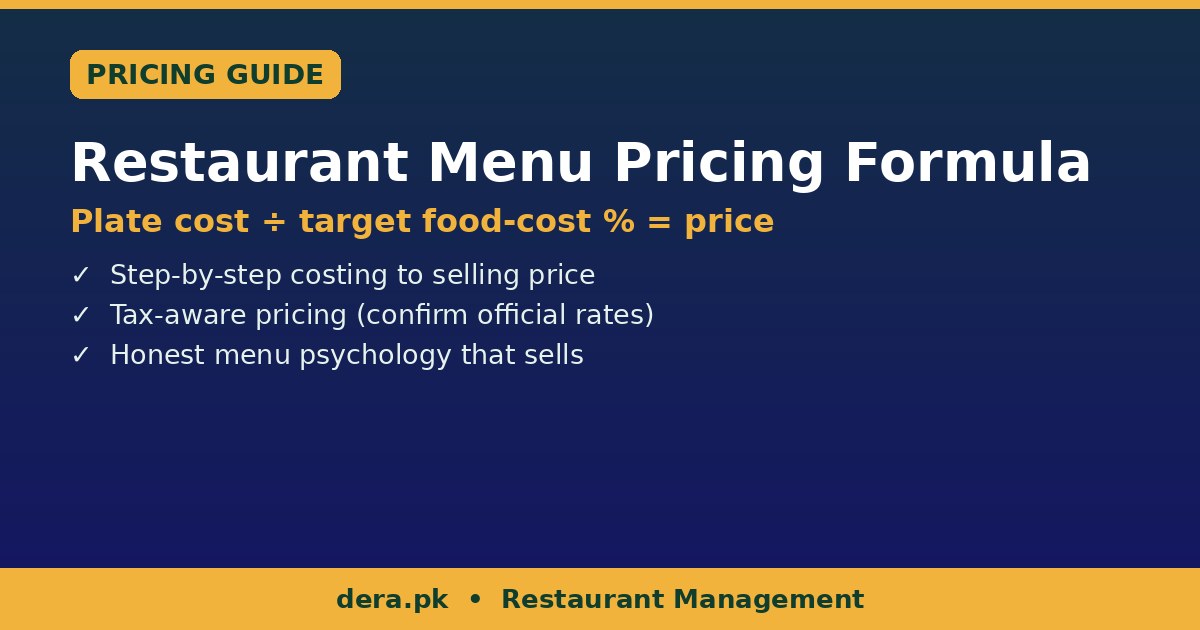
Direct answer: The basic restaurant menu pricing formula is Selling price = Plate cost ÷ Target food-cost percentage. First cost the dish (ingredients + usable yield), choose a target food-cost % that still covers rent, labour, utilities, delivery commission and profit, then set a price customers will pay versus nearby competitors. After that, apply light menu psychology (design, item order, decoy anchors) — never as a substitute for real costing. In Pakistan, also decide whether listed prices are tax-inclusive or tax-exclusive using the sales-tax rules for your city (confirm officially; do not guess).
This guide is for owners and chefs who still price by “what the next shop charges”.
What is menu pricing?
Menu pricing is the process of deciding what to charge for each item so that:
- Guests feel the price is fair for taste and portion.
- Every plate contributes to overhead and profit after real costs.
- The menu as a whole balances high-margin and traffic-building items.
Guessing prices from Instagram photos of other restaurants is not a strategy.
What is the restaurant menu pricing formula?
Step 1 — Calculate plate cost
Use a recipe costing sheet:
Plate cost = total ingredient cost for the recipe ÷ number of portions
Include oil, spices, garnish and packaging for delivery versions. Factor yield (bone, trim, evaporation). See the worked karahi example in our recipe costing sheet and how a chef can hide food cost.
Step 2 — Choose a target food-cost percentage
Food cost % = Plate cost ÷ Selling price × 100
Rearranged for pricing:
Selling price = Plate cost ÷ Target food-cost %
Example structure (illustrative maths only, not a market claim):
- Plate cost = Rs 300
- Target food cost = 30% (0.30)
- Selling price = 300 ÷ 0.30 = Rs 1,000 before you consider tax display and psychology rounding
There is no official “correct” food-cost % for Pakistani restaurants. A fine-dining room with high rent may need a lower food-cost % (higher price relative to ingredients). A high-volume dhaba may run higher food-cost % if labour and rent are lower. Set the target from your monthly P&L, not from a motivational reel.
Step 3 — Stress-test against overhead
Food cost is only one line. Before you lock the price, ask:
- Does contribution after food still cover labour for that daypart?
- What if oil and chicken jump 10% next month?
- What if 40% of sales go through a delivery app with commission?
Delivery commission %: [needs verification – check the official source] on your signed partner package (Foodpanda and others show package rates during registration; they are not one public fixed number).
Step 4 — Round to a sellable number
After the formula, round to clean price points your market accepts (for example ending in 0 or 9 — test what your regulars trust). Then print.
How should sales tax affect menu prices?
Sales tax on restaurant services depends on province/territory. Examples verified from official pages elsewhere in this series:
- Sindh (SRB): public page states 15% generally for restaurant services from 1 July 2024, with 8% for specified digital payments (srb.gos.pk/srb/other-services/).
- ICT: ordinance updated to 30 June 2025 states 5% for specified digital payments (no input tax adjustment) and 15% for cash (FBR ICT ordinance PDF).
- Punjab restaurant-specific current rate: [needs verification – check the official source] on PRA’s latest schedule (PRA FAQ quotes a 16% standard services rate).
Decide:
| Approach | Meaning | Watch-out |
|---|---|---|
| Tax-exclusive menu | Price + tax on bill | Guest surprise at payment |
| Tax-inclusive menu | Tax inside printed price | You must still configure POS correctly |
Never print “GST included” if you are not actually registered and remitting. Wrong tax on bills is a legal problem, not a design choice.
Menu pricing psychology (that does not feel dishonest)
Psychology should help guests choose; it should not hide unsafe food or fake discounts.
1. Eye magnets
Put high-profit signature dishes where eyes land first: top-right of a page or first in a category, with a short mouth-watering line — not a paragraph.
2. Decoy / anchor items
A premium platter at a high price can make the mid-tier family deal feel reasonable. The premium item must still be a real dish you can execute.
3. Bundle pricing
Combo of karahi + drinks + naan can raise average ticket while feeling like value. Cost the bundle as carefully as single items.
4. Limit choice
Too many chicken dishes slows service and increases waste. A tight menu prices clearer and cooks better.
5. Avoid fake “was / now” tags
If you never sold at the “was” price, the tactic damages trust when regulars notice.
6. Photo honesty
Delivery photos that look 2× the real portion create refunds and one-star reviews that cost more than a slightly lower price.
Competitive check (Pakistan practical)
After formula pricing:
- Visit 3 nearby competitors at the same daypart.
- Note portion size, not only price (weigh leftover bones if you must — privately).
- Decide whether you compete on portion, taste, ambience or speed.
- Do not race to the bottom on chicken karahi if your rent is 3× theirs.
Worked mini example (structure only)
Assume a burger:
| Element | Note |
|---|---|
| Patty + bun + veg + sauce + box | Sum = plate cost |
| Target food cost % | From your P&L |
| Formula price | Plate ÷ target % |
| Delivery version | Add stronger box + sleeve; re-cost |
| Dine-in version | Maybe lower packaging cost |
| Final board price | Rounded; tax policy applied |
Replace every number with your invoice costs the week you print the menu.
When should I change menu prices?
- Ingredient costs move beyond your buffer for several weeks
- Rent or minimum wage/labour cost steps up
- You launch or leave a high-commission channel
- Food-cost reports show a category consistently underwater
Communicate clearly to regulars; sudden silent hikes feel worse than an honest rewrite with one improved recipe.
Link pricing to operations
Price is useless if portions swing by cook. Fix scoops, spoons and SOPs first — see kitchen discipline in the kitchen checklist and training in the staff training manual. Managers should spot-check plates during peak using the restaurant manager duties checklist: watch the product, not only the cash drawer.
Common menu pricing mistakes
- Copying competitor prices without costing.
- Ignoring packaging for delivery items.
- One price for dine-in and delivery despite different cost stacks.
- Never updating prices when chicken rises for three months.
- Designing a pretty menu before the maths.
- Using psychology tricks on a loss-making item hoping volume will “sort it”.
FAQ
What is the menu pricing formula?
Selling price = plate cost ÷ target food-cost percentage. Then adjust for overhead, tax display, competition and rounding.
What is a good food-cost percentage?
No single official figure. Calculate from your own rent, labour and profit needs; track weekly.
How does menu pricing psychology work?
It guides attention and choice through layout, anchors and bundles. It must sit on top of honest costing, not replace it.
Should delivery prices be higher?
Often yes if packaging and commission increase cost. Confirm commission in your contract: [needs verification – check the official source].
Should prices include sales tax?
Follow your registration and local rules (SRB / PRA / ICT etc.). Confirm current rates on official sites before printing.
How often should I revise the menu?
Review costs monthly; redesign the full menu when several categories drift or the concept changes.
Sources
- Sindh Revenue Board restaurant tax summary (15% / 8% digital incentive): https://www.srb.gos.pk/srb/other-services/
- ICT (Tax on Services) Ordinance consolidated PDF (updated to 30 June 2025): https://download1.fbr.gov.pk/Docs/2025711172945966ICTOUpdatedupto30.06.2025.pdf
- Punjab Revenue Authority FAQs (standard services rate 16%): https://reg.pra.punjab.gov.pk/ptms/Faqs.aspx
- Foodpanda partner FAQ (commission shown in package during registration): https://partner.foodpanda.pk/en
Last checked: 4 November 2026 (America/Los_Angeles). Tax and commission figures change — confirm on official pages and your contracts.