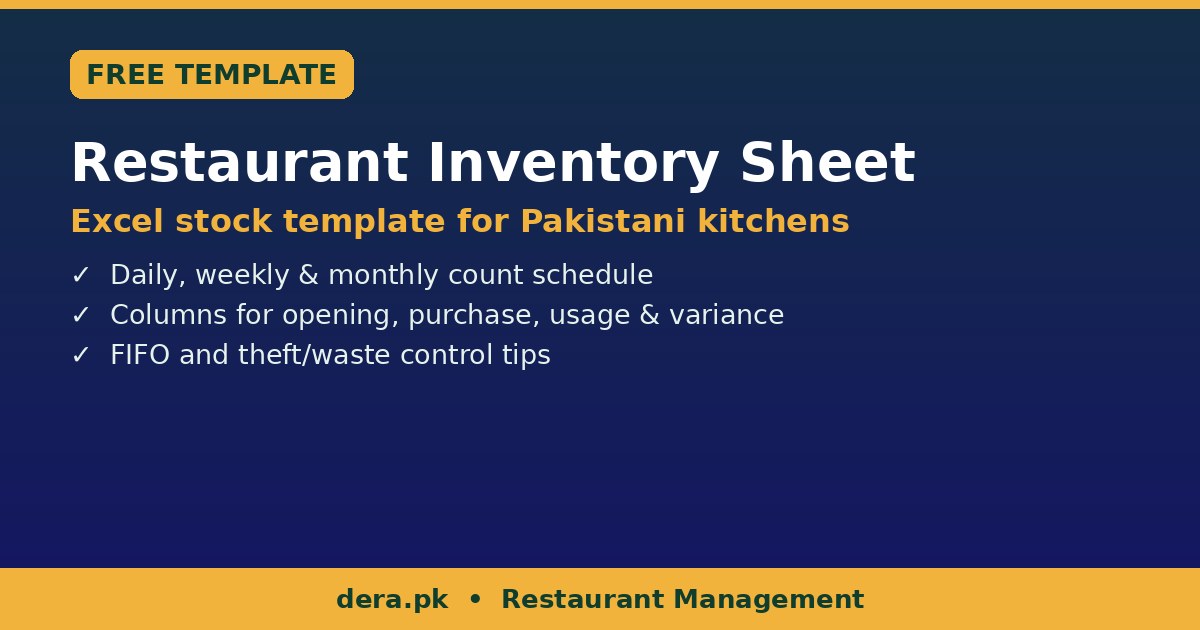
Restaurant Inventory Sheet: Stock Management Excel Guide for Pakistan
Direct answer: A restaurant inventory sheet is a simple table that lists every stock item, opening quantity, purchases, usage (or closing count), and the difference (variance). Count what is on the shelf, compare it to what the sheet says should be there, and investigate gaps. You can run this in Excel, Google Sheets or a notebook — software helps later, but the habit of counting matters more than the app logo.
This guide is for Pakistani restaurant, dhaba, café and cloud-kitchen owners who lose money in the store room without noticing.
What is restaurant inventory management?
Inventory management means knowing what you bought, what you used, and what is left — for chicken, oil, flour, soft drinks, packaging and cleaning chemicals. In many Pakistani kitchens the “system” is the head cook’s memory. That works until prices jump, a cook leaves, or monthly profit disappears into “wastage”.
A written inventory sheet gives you:
- A weekly snapshot of stock value
- Early warning when usage is abnormally high (theft, over-portioning, spoilage)
- A buying list based on real need, not panic purchases
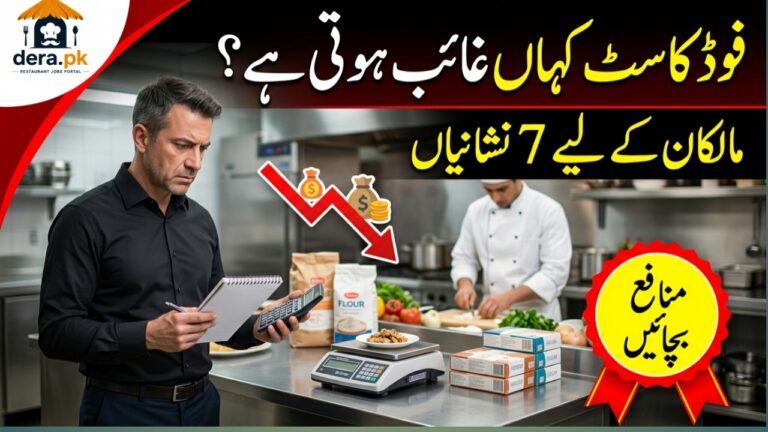
- Evidence when you discuss food cost with the chef — see how a chef can hide food cost
What columns should a restaurant inventory sheet have?
Copy this layout into Excel (one row per item):
| Column | Example | Why it matters |
|---|---|---|
| Item name | Chicken breast | Use the name staff actually say |
| Category | Meat / Dairy / Dry / Veg / Packaging | Filters and counts by store |
| Unit | kg / litre / piece / dozen | Never mix units in one row |
| Opening stock | 12 kg | From last closing count |
| Purchases | 20 kg | From invoices this period |
| Closing stock (count) | 8 kg | Physical count today |
| Usage (calculated) | Opening + Purchases − Closing | Theoretical consumption |
| Unit cost (PKR) | From latest invoice | Refresh when prices change |
| Stock value | Closing × Unit cost | For total inventory value |
| Variance notes | “2 kg spoiled” / “OK” | Explains gaps |
| Counted by / Date | Name + date | Accountability |
Usage formula:
Usage = Opening stock + Purchases − Closing stock
If recipe costing says 100 portions needed 40 kg chicken but usage shows 52 kg, you have a portion, waste or theft problem — not a “market rate” problem.
Daily vs weekly vs monthly inventory — what should I count?
You do not need to count every spice packet every night.
Count daily (high risk / high value)
- Chicken, mutton, beef, fish
- Cheese, cream, butter (if used heavily)
- Cooking oil (mark the tin level)
- Soft drinks and mineral water (easy to “gift”)
- Packaging for delivery (boxes disappear fast)
Count weekly
- Dry goods: rice, flour, pulses, spices in bulk
- Sauces and tins
- Cleaning chemicals
- Disposable cups/straws if volume is medium
Count monthly
- Equipment-related stock (gas cylinders log, charcoal)
- Full store valuation for accounts
- Slow movers you might stop buying
Put the schedule on the restaurant opening/closing checklist so it is not optional.
How do I take a physical stock count in a busy kitchen?
- Freeze issues for 15–20 minutes if possible, or count after last order.
- One counter + one writer. The cook should not both count and fill the sheet alone for high-value items.
- Count in storage units (kg on the scale, not “about two boxes”).
- Open every fridge and freezer. Forgotten containers are still stock — or waste.
- Use FIFO labels. Write receive date on every pack. First in, first out reduces spoilage.
- Sign the sheet. Unsigned counts become arguments.
What is FIFO in a restaurant store?
FIFO means First In, First Out: older stock is used before newer stock. In Pakistani kitchens this stops a new rice bag being opened while an older damp bag sits behind it. Write the delivery date with a marker on each bag and tin.
Excel template: simple weekly inventory (copy/paste)
Create a sheet named Weekly_Stock with headers:
A: Item | B: Unit | C: Opening | D: Purchase | E: Closing | F: Usage (=C+D-E) | G: Unit_Cost | H: Value (=E*G) | I: Notes
Tips that work on a cheap laptop:
- Freeze the header row.
- Use data validation dropdowns for Unit and Category.
- Keep a separate
Price_Listtab updated from supplier invoices. - Protect the Usage and Value formula columns so staff only edit counts.
- Save a dated copy every Sunday (
Stock_2026-11-09.xlsx) instead of overwriting forever.
You do not need paid “restaurant inventory software” on day one. When you have multiple branches or thousands of SKUs, then compare apps — still keep physical counts.
How does inventory connect to recipe costing and menu prices?
Inventory tells you what left the store. Recipe costing tells you what should have left the store for the number of plates sold. Build that side with our recipe costing sheet, then set prices with the restaurant menu pricing formula.
Example workflow:
- POS says 80 chicken karahi sold.
- Recipe says 0.35 kg chicken per portion → expected 28 kg.
- Inventory usage shows 36 kg.
- Gap = 8 kg → investigate portion scoops, bone weight, staff meals, spoil, or theft.
Without both sheets, owners argue opinions. With both, you manage facts. Train kitchen discipline with clear SOPs and the habits in our staff training plan.
Stock management rules that work in Pakistani restaurants
- One receiving person. Not every rider and waiter’s cousin unpacks the chicken.
- No store key for everyone. Manager + one storekeeper.
- Staff meals recorded. Free food is fine if it is logged; hidden free food destroys food cost.
- Supplier invoice = purchase entry the same day. Do not “enter later”.
- Quarantine damaged goods. Do not mix spoilt produce back onto the prep table.
- Separate cleaning chemicals from food shelves — basic hygiene expected in food authority inspections.
- Delivery packaging counted like food. Boxes are money.
Paper PDF vs Excel vs app — which should I use?
| Tool | Best for | Limit |
|---|---|---|
| Printed PDF / notebook | Single small dhaba, low literacy team | Hard to total value; easy to lose |
| Excel / Google Sheets | Most independent restaurants | Needs one person who can maintain formulas |
| Inventory app / POS add-on | Multi-branch, large SKU lists | Cost + training; still needs physical counts |
Start with Excel. Upgrade only when the sheet is already being used every week.
Common inventory mistakes
- Counting in “boxes” without converting to kg.
- Letting the same person purchase, receive and count.
- Updating purchase prices once a year while the market moved monthly.
- Ignoring butchery yield (whole chicken vs boneless).
- No variance meeting — counting without asking “why”.
- Buying bulk deals that expire before you can sell the dishes.
Sample weekly closing meeting (15 minutes)
- Total stock value this week vs last week
- Top 5 variances by PKR
- Items near expiry
- Next week’s purchase list (only what the sheet supports)
- One process fix (new scoop size, new lock, new label rule)
Keep minutes in the same folder as the sheet.
FAQ
What is a restaurant inventory sheet?
A structured list used to record opening stock, purchases, closing counts and calculated usage for each kitchen and store item.
How do I make a restaurant inventory sheet in Excel?
Create columns for item, unit, opening, purchase, closing, usage formula, unit cost and value; count physically; update purchases from invoices.
How often should a restaurant take inventory?
Daily for high-value items (meat, oil, drinks), weekly for dry goods, monthly for full valuation — adjust to your volume.
What is the difference between inventory and stock management?
People use the words interchangeably. In practice both mean controlling what you buy, store, use and recount so waste and theft stay visible.
Do I need restaurant inventory software?
Not at the start. Excel plus honest counts beat an unused app. Consider software when multiple outlets or large catalogues make sheets painful.
How does inventory reduce food cost?
It surfaces gaps between theoretical usage (from recipes × sales) and actual usage, so you can fix portioning, spoilage and theft.
Sources
- No fee, tax, commission or legal rate figures are stated in this article.
- Punjab Food Authority (hygiene/storage expectations for food businesses in Punjab): https://pfa.gop.pk
Last checked: 4 November 2026 (America/Los_Angeles).